Martyr · 5 min read
St. Alban
Alban is venerated as the first-recorded British Christian martyr, for which reason he is considered to be the protomartyr of Britain.
Listen to this story with read-aloud →
Feast day: June 20
Commemorations can vary by local and liturgical calendar; the biography records the traditions associated with this saint.
Devotional associations: converts, refugees, torture victims
In this story
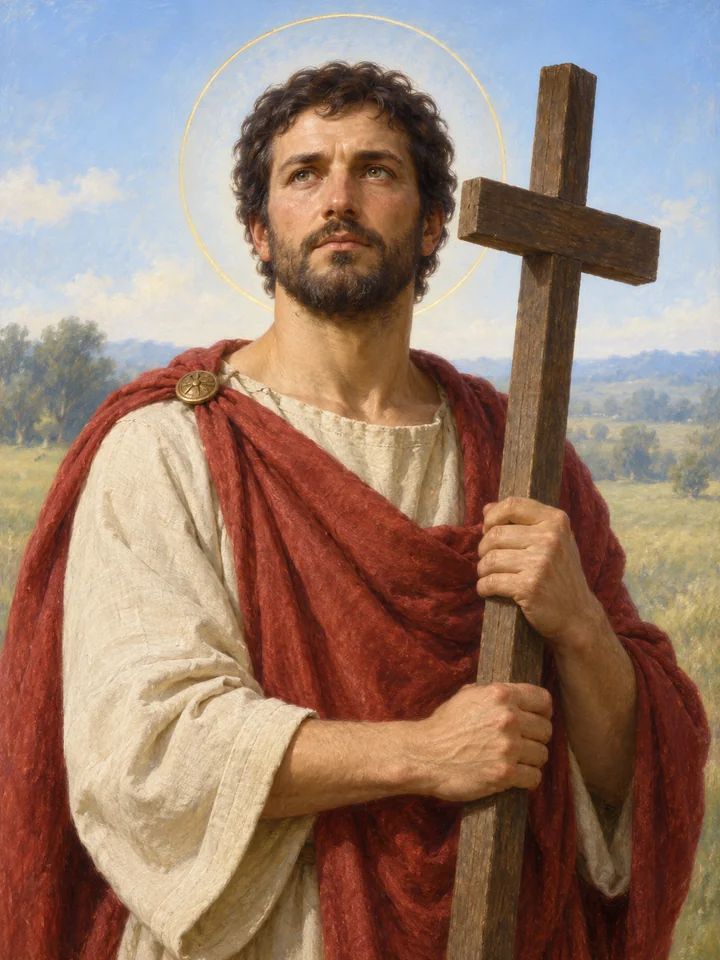
Saint Alban (/ ˈ ɔː l b ən, ˈ æ l -/; Latin: Albanus) is venerated as the first-recorded British Christian martyr, for which reason he is considered to be the protomartyr of Britain. Along with fellow Saints Julius and Aaron, Alban is one of three named martyrs recorded at an early date from Roman Britain (Amphibalus was the name given much later to the priest he was said to have been protecting). He is traditionally believed to have been beheaded in Verulamium (modern-day St Albans) sometime during the 3rd or 4th century, and has been celebrated there since ancient times.
Life and hagiography
Sparse records testify that Alban was a Roman citizen living in Verulamium around AD 300. Nothing is known of his background or age. The story of his trial and execution were told in several sources. The earliest reference to Alban's martyrdom is in the Life of Germanus by Constantius of Lyons (written between 460 and 480). According to this account Germanus visited Alban's tomb in 429. However, Verulanium was not mentioned by Constantius. A later British writer, Gildas, wrote around 547 and referred to 'Alban of Verulanium' and gave a recognisable account of the execution. which he places in Londinium as he refers to crossing the Thames before the execution.
Bede's account
One of the best known accounts is that of Bede's Ecclesiastical History of the English People, written in 731.
In the 3rd or 4th century (see dating controversy below), Christians began to suffer cruel persecution. However, Gildas says he crossed the Thames before his martyrdom, so some authors place his residence and martyrdom in or near Londinium. Both agree that Alban met a priest fleeing from persecutors and sheltered him in his house for a number of days. The priest, who later came to be called Amphibalus (Latin for "cloak"), prayed and "kept watch" day and night, and Alban was so impressed by the priest's faith and piety that he found himself emulating him and soon converting to Christianity. Eventually, it came to the ears of an unnamed "impious prince" that Alban was sheltering the priest. The prince gave orders for Roman soldiers to make a strict search of Alban's house. As they came to seize the priest, Alban put on the priest's cloak and clothing and presented himself to the soldiers in place of his guest.
Alban was brought before a judge, who just then happened to be standing at the altar, offering sacrifices to devils (Bede's reference to pagan 'gods'). When the judge heard that Alban had offered himself up in place of the priest, he became enraged that Alban would shelter a person who "despised and blasphemed the gods," and, as Alban had given himself up in the Christian's place, Alban was sentenced to endure all the punishments that were to be inflicted upon the priest, unless he would comply with the rites of their pagan religion. Alban refused, and declared, "I worship and adore the true and living God who created all things." (The words are still used in prayer at St Alban's Abbey). The enraged judge ordered Alban to be scourged, thinking that a whipping would shake the constancy of his heart, but Alban bore these torments patiently and joyfully. When the judge realized that the tortures would not shake his faith, he gave orders for Alban to be beheaded.
Alban was led to execution, and he presently came to a fast-flowing river that could not be crossed (believed to be the River Ver). There was a bridge, but a mob of curious townspeople who wished to watch the execution had so clogged the bridge that the execution party could not cross. Filled with an ardent desire to arrive quickly at martyrdom, Alban raised his eyes to heaven, and the river dried up, allowing Alban and his captors to cross over on dry land. The astonished executioner cast down his sword and fell at Alban's feet, moved by divine inspiration and praying that he might either suffer with Alban or be executed for him.
The other executioners hesitated to pick up his sword, and meanwhile, Alban and they went about 500 paces to a gently sloping hill, completely covered with all kinds of wildflowers, and overlooking a beautiful plain. (Bede observes that it was a fittingly beautiful place to be enriched and sanctified by a martyr's blood.)
When Alban reached the summit of the hill, he began to thirst and prayed God would give him water. A spring immediately sprang up at his feet. It was there that his head was struck off, as well as the head of the first Roman soldier who was miraculously converted and refused to execute him. However, immediately after delivering the fatal stroke, the eyes of the second executioner popped out of his head and dropped to the ground, along with Alban's head, so that this second executioner could not rejoice over Alban's death.
Other legends
In later legends, Alban's head rolled downhill after his execution, and a well sprang up where it stopped. Upon hearing of the miracles, the astonished judge ordered further persecutions to cease, and he began to honour the saint's death.
St Albans Cathedral now stands near the believed site of his execution, and a well is at the bottom of the hill, Holywell Hill.
Biography adapted from Wikipedia contributors under CC BY-SA 4.0. Read attribution and adaptation details.