Monastic or Hermit · 2 min read
St. Amalberga of Maubeuge
Amalberga of Maubeuge was a Merovingian nun and saint who lived in the 7th century.
Listen to this story with read-aloud →
Feast day: July 10
Devotional associations: arm pain, bruises, and fever
In this story
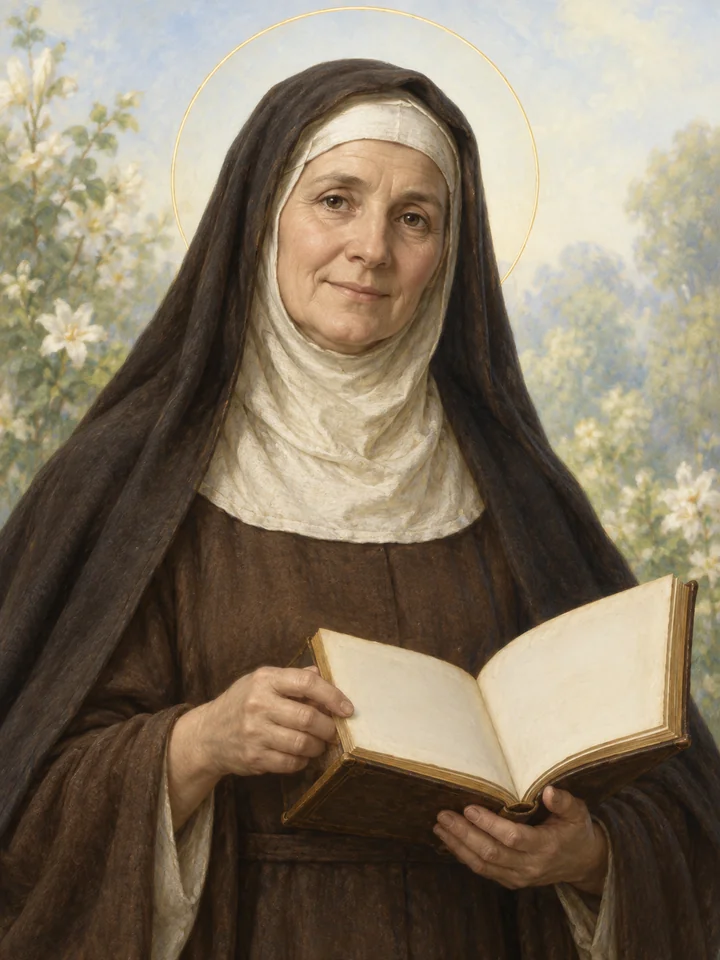
Saint Amalberga of Maubeuge (also Amalia, or Amelia of Lobbes or Binche) was a Merovingian nun and saint who lived in the 7th century.
Legend
Amalberga's father was Saint Geremarus. She was born in Brabant. She is said to have been the niece of Pepin of Landen who married her against her will to a great lord, named Thierry, by whom she had a daughter, afterwards St. Pharailda.
Upon the death of her first husband, Pepin had her marry Count Witger, Duke of Lorraine. In her biography she is presented as the mother of five saints: Pharaildis, Emebert, Reineldis, Ermelindis and Gudula.
Sometime after the birth of their youngest child, Gudula, Witger decided to become a Benedictine in Lobbes; Amalberga joined the Benedictine nuns of Maubeuge.
Her feast is celebrated on July 10. The translation of her relics from Lobbes to Binche in the 15th century is celebrated on June 10.
Amalberga of Maubeuge is not to be confused with the virgin Amalberga of Temse (venerated in Ghent, Temse and Munsterbilzen) who died in 772, and whose feast day is July 10 or October 27.
History
The biography of Amalberga of Maubeuge (Vita sancti Amalbergae viduae) is probably written by Abbott Hugo of Lobbes (1033–1063) between 1033 and 1048. Apart from a few Merovingian details, her genealogy was copied from another 11th-century hagiography, namely the Passio sancti Katharinae. The biographical profile of her legendary husband, duke Witger of Lotharingia, is based on an historical figure from the 10th century, Wigeric of Lotharingia. It is largely considered legendary and unreliable.
Feast days
20 June - translation of relics from Lobbes to Binche
2 July - translation of relics from Lobbes to Binche
10 July - main commemoration
Biography adapted from Wikipedia contributors under CC BY-SA 4.0. Read attribution and adaptation details.