Bishop · 15 min read
St. Jacob of Serugh
Jacob of Serugh was one of the foremost poets and theologians of the Syriac Christian tradition and authors of Syriac literature, second only to Ephrem the Syrian and equal to Narsai.
Listen to this story with read-aloud →
Feast day: November 29
In this story
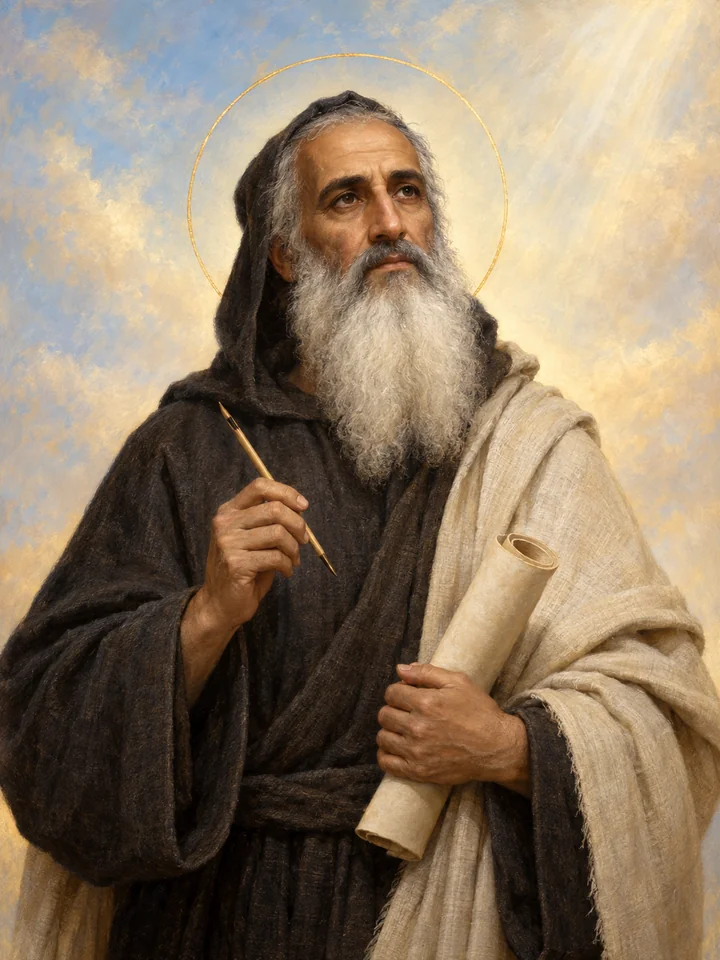
Jacob of Serugh (Syriac: ܝܥܩܘܒ ܕܣܪܘܓ, romanized: Yaʿquḇ daSruḡ, Classical Syriac pronunciation: [ ˌjaˤˈquβ das'ruɣ ]; Latin: Iacobus Sarugiensis; c. 452–521), also called Jacob of Sarug or Mar Jacob (Syriac: ܡܪܝ ܝܥܩܘܒ, romanized: Mār Yaʿquḇ), was one of the foremost poets and theologians of the Syriac Christian tradition and authors of Syriac literature, second only to Ephrem the Syrian and equal to Narsai. He lived most of his life as an ecclesiastical official in Suruç, in modern-day Turkey. He became a bishop (of Batnan) near the end of his life in 519. He was a Miaphysite (Oriental Orthodox Non-Chalcedonian Christianity), albeit moderate compared to his contemporaries.
Jacob is best known for the homilies he wrote in the late fifth and early sixth centuries. He wrote in prose, as well as in 12-syllable (dodecasyllabic) meter, which he invented, and he was known for his eloquence. According to Jacob of Edessa, he composed 763 works during his lifetime. Around 400 survive, and over 200 of those have been published. The longest is about 1,400 verses. By the time of his death, he had a great reputation. His works were so popular that of any author from late antiquity, only the writings of Augustine of Hippo and John Chrysostom survive in a greater number of manuscripts than Jacob's.
His work earned him many nicknames, including "Flute of the Holy Spirit" (which also belonged to his predecessor Ephrem the Syrian), and "Lyre of the Believing Church" (in Antiochene Syriac Orthodox Christianity). Both Non Chalcedonian and Chalcedonian traditions of Christianity now take him as a saint.
Life
Jacob was born around the middle of the fifth century in the village of Kurtam (ܟܘܪܬܘܡ) on the Euphrates in the ancient region of Serugh, which stood as the eastern part of the province of Commagene (corresponding to the modern districts of Suruç and Birecik). He was educated in the famous School of Edessa and became chorepiscopus back in the Serugh area, serving rural churches of Haura (ܚܘܪܐ, Ḥaurâ). His tenure of this office extended over a time of great trouble to the Christian population of Mesopotamia, due to the fierce war carried on by the Sasanian emperor Kavadh I within the Roman borders.
In 519 and at the age of 67, Jacob was elected bishop of the main city of the area, called in Syriac Baṭnān d-Sruḡ (ܒܛܢܢ ܕܣܪܘܓ). As Jacob was born in the same year as the controversial Council of Chalcedon, he lived through the intense rifts that split Eastern Christianity, which led to most Syriac speakers being separated from Chalcedonian Christianity. Even though imperial persecution of anti-Chalcedonians became increasingly brutal towards the end of Jacob's life, he remained surprisingly quiet on such divisive theological and political issues. However, when pressed in correspondence by Paul, bishop of Edessa, he openly expressed dissatisfaction with the proceedings of Chalcedon and overall Dyophysite Christology.
Little more is known about the life of Jacob, as Jacob's biography was not documented in detail. One contemporary account of his life, the Chronicle of Pseudo-Joshua the Stylite, focuses on his vast literary output and its wide distribution:
The honored Jacob, the periodeutes by whom many homilies were composed on sections of the scriptures and songs and canticles constructed for the time of the locusts, also did not turn away in this time from what was appropriate for him. Rather he wrote admonitory letters to all the cities, making them trust in the salvation of God and encouraging them not to flee.
One manuscript written two years after his death calls him the "bishop of Batnae". Some information about Jacob's life can also be gleaned from his writings. For example, he writes in his correspondence with monastery of Mar Bassus:
Forty-five years ago, I was dwelling in the city of Edessa in the study of the divine scriptures, at the time when the writings of the wicked Diodoros were being translated from Greek into Syriac. In the city there was a school of the Persians that adhered to the thought of the foolish Diodoros with much affection, and the whole East was corrupted by that school.
Literary activity
Jacob's style was to write in the genres of metrical homily (mimre) and madroshe (narrative or verse poems without strophies), sugyoto (dialogue poems with an acrostic), and turgome (prose homilies for liturgical feasts).
Jacob's literary activity was unceasing. According to Bar Hebraeus (Chron. Eccles. i. 191) he employed 70 amanuenses and wrote in all 760 metrical homilies, besides expositions, letters and hymns of different sorts. Jacob's style was to write in dodecasyllabic metre, dealing mainly with biblical themes, but also on the deaths of Christian martyrs, the fall of the idols and the First Council of Nicaea.
Of Jacob's prose works, which are not nearly so numerous, the most interesting are his letters, which throw light upon some of the events of his time and reveal his attachment to Miaphysitism, which was then struggling for supremacy in the Syriac churches, and particularly at Edessa, over the opposite teaching of Nestorius.
The Hexaemeron of Jacob of Serugh was the first Hexaemeral work (dedicated commentary to the Genesis creation narrative) to be composed in Syriac. He was followed by other authors, such as Jacob of Edessa's own Hexaemeron.
Christology
Jacob of Serugh held a Miaphysite doctrine. Although he was reluctant to directly engage in the controversies over Christology in his time, his homilies contain some apparent criticisms of Chalcedonian Christianity (that is, the group that accepts the decrees of the Council of Chalcedon) and Jacob accepted reconciliation between the Chalcedonian and non-Chalcedonian positions in Zeno's Henotikon. Despite his ultimately non-Chalcedonian views, his work was nevertheless widely received across Christological confessions, including among Chalcedonian, Maronite, and Church of the East communities, especially given his homilies general avoidance of overtly polemical terminology, and his use of his vehicles as a vehicle for disseminating complex and technical contemporary debates on Christology to wider audiences in simple terms.
A recurring feature of Jacob's Christological language is the pairing of Christ's "miracles and sufferings", a phrase that had become important in post-Chalcedonian controversy through texts such as Leo's Tome and the emperor Zeno's Henotikon. Jacob used this pairing to affirm that the same Christ performed divine acts and underwent human sufferings, while rejecting interpretations that he regarded as dividing Christ into two. Forness identifies four homilies in particular as especially important in showing how Jacob incorporated post-Chalcedonian Christological debate into biblical exposition and catechetical preaching: the Homily on the Council of Chalcedon, the Homily on the Faith, the Homily on "The Lord will Raise a Prophet", and the Homily on the Revelation that Simon Received.
Political affairs
Towards the end of his life, the fate of Miaphysite leaders such as himself took a turn for the worse with the accession of Justin I (r. 518–527) to the throne of the Byzantine Empire. In response to these affairs, Jacob composed two letters and they were composed in the following context. First, on March 28, 519, Justin adopted a pro-Chalcedonian text known as the Formula of Faith which had been written by Pope Hormisdas a few years beforehand, in 515. However, Paul of Edessa, the bishop of Edessa, refused to sign the text, which led Justin to lay siege to the city in November. Paul was exiled, but after forty days was allowed to be let back into the city in December. Immediately thereafter, Jacob wrote his Letter 32 to Paul. In it, he called Paul a "confessor", a title reserved for those who were persecuted but not killed for their faith. Jacob believed that Paul's refusal to sign the text was correct. After a military leader named Patricius invaded Edessa to, Jacob then composed his Letter 35 to the military leader of the city, Bessas. Bessas is praised for his faith which has helped to exalt the city. Jacob recognizes the suffering Bessas had endured for his faith as well and compares him with Abgar of Edessa, the man credited with introducing Christianity to Edessa. To some surprise, aside from praising these two, Jacob also praised the faith of Justin in his letter to Paul: for allowing Paul to return to the city, by comparing him to Abgar, by describing his crown which displays features of the cross of Jesus, and more.
Another affair that Jacob became somewhat involved in was during the persecutions of the Christian community of Najran under the Jewish Himyarite king Dhu Nuwas, which had caused widespread reactions in the world of Syriac Christianity. Between 518 and 521, Jacob composed his Letter to the Himyarites to help extol them for their faith and their endurance. This text is also the only extant literary composition that was sent into pre-Islamic Arabia.
Reception and memory
Sa'id bar Sabuni (d. 1095) wrote an 1106-line metrical homily in his honor, called The Vita of Jacob of Serugh, performed in order to commemorate the day of his death on November 29. Many more lives/ Vitas were written for Jacob's memory, like Habib of Edessa's On Jacob of Serugh.
Jacob's reputation as an author and composer also led many to write new works in his name, a famous example being the Song of Alexander.
Quranic studies
Historians have long observed that the Quran presents versions of biblical and biblically related stories that differ from, or even do not appear in, the Bible. In recent years, Syriac Christianity has been identified as key intermediary and link, showing that the differences between the two texts slowly emerged during Late Antiquity, especially within circles of Syriac Christians. The homilies of Jacob of Serugh, in specific, typically contain some of the closest versions of ideas and narratives compared with those in the Quran, the scripture of Islam, which has made them an increasingly important primary source in field of Quranic studies. Key examples include narrative and eschatology and apocalypse.
Works
Jacob is famous for his metrical homilies, written in 12-syllable (dodecasyllabic) verse. According to Bar Hebraeus, Jacob composed over 760 homilies. About 400 have survived, and almost all have appeared in critical editions, primarily in the 6-volume Bedjan-Brock edition (1905–10, 2006) and the 2-volume Akhrass-Syryany edition (2017). A complete numbered list of Jacob's extant homilies was published in Akhrass 2015. As of 2018, 20% of the homilies in the Bedjan-Brock edition have been translated. An ongoing translation project by Gorgias Press aims to bring his entire corpus into English.
Jacob also wrote outside of the genre of metrical homily. Jacob wrote stanzaic poetry (with 25 translated to date), prose homily (8 extant), and other prose works like letters.
Manuscripts
Jacob's homilies are found in a substantial number of surviving manuscripts. The earliest are from the sixth and seventh centuries, and massive manuscripts have also been recovered produced in the eleventh-thirteenth centuries containing up to two hundred of Jacob's homilies. A distinct transmission of manuscripts of Jacob's writings also permeated monastic circles.
Critical editions
Poetry
All ~400 of the poems of Jacob of Serugh have, today, appeared in published critical editions. Paul Bedjan and Sebastian Brock have, together, published critical editions of 211 of Jacob's homilies across six volumes of work.
Volume 1: Homilies 1–32 (Bedjan)
Volume 2: Homilies 33–70 (Bedjan)
Volume 3: Homilies 71–107 (Bedjan)
Volume 4: Homilies 108–146 (Bedjan)
Volume 5: Homilies 147–195 (Bedjan)
Volume 6: Homilies 196–206 (Bedjan), 207–211 (Brock)
The first five volumes were produced by Bedjan between 1905–1910. In 2006, Brock collected critical editions by Bedjan of a few scattered remaining homilies, and added some of his own, to produce the sixth volume. All six volumes can now be accessed in a single six-volume set by Gorgias Press.
Mar Jacobus Sarugensis (1905). Paulus Bedjan (ed.). Homilae selectae Mar-Jacobi Sarugensis (in Syriac and French). Paris: Otto Harrassowitz.
Homilies of Mar Jacob of Sarug (6-volume set)
Miscellaneous contributions by other authors over the years (including Albert, Stothman, Mouterde, Alwan, and others) raised the total to 243 homilies with critical editions.
In 2017, critical editions were published for Jacob's remaining 160 homilies by Roger Akhrass and Imad Syryany.
Roger Akhrass and Imad Syryany, 160 Unpublished Homilies of Jacob of Serugh, 2 vols., Damascus: Department of Syriac Studies
Prose
In total, Jacob is known to have written 43 letters (prose works). A critical edition of all letters was published in 1952 by Gunnar Olinder.
Iacobus Sarugensis (1952). G Olinder (ed.). Iacobi Sarugensis epistulae quotquot supersunt. Corpus scriptorum Christianorum Orientalium, Scriptores Syri, v. 57. Louvain.
Translations
Manuscripts of Jacob's homilies are also found in multiple languages beyond Syriac to which they were translated, including Coptic, Georgian, Armenian, Arabic, and Ethiopic. The number of Jacob's works translated into Arabic number over one hundred, and there are over two hundred Armenian manuscripts of them that date from the twelfth to twentieth centuries.
In modern-times, Behnam Sony has composed a five-volume translation of Jacob's writings into Arabic.
In European languages, Jacob's writings have been widely translated into English, German, French, and Italian.
From the eighteenth century onwards, new discoveries of manuscripts of Jacob's works have sparked no less than three debates over his Christology.
List of translations
Homilies on specific figures
Mary, mother of Jesus — Jacob of Serug (1998). Mary Hansbury (ed.). On the Mother of God. Crestwood, New York, US: St. Vladimir's Seminary Press. ISBN 0-88141-184-1. Also — Giacomo de Sarug (1953). Constantino Vona (ed.). Omelie mariologiche. Lateranum: nova ser., an. 19, n. 1-4 (in Italian). Rome: Facultas Theologica Pontificii Athenaei Lateranensis.
Women whom Jesus met — Susan Ashbrook Harvey; Sebastian P. Brock; Reyhan Durmaz; Rebecca Stephens Falcasantos; Michael Payne; Daniel Picus, eds. (2016). Jacob of Sarug's homilies on the Women whom Jesus Met. Texts from Christian Late Antiquity. Vol. 44. Piscataway, N. J.: Gorgias Press. ISBN 978-1-4632-0580-5.
Veil of Moses — Brock, Sebastian Paul (1981). "Jacob of Serugh on the Veil of Moses". Sobornost'/Eastern Churches Review. 3 (1): 70– 85.
Ephrem the Syrian — Jacob of Sarug (1995). Joseph P Amar (ed.). A metrical homily on holy Mar Ephrem. Patrologia Orientalis; t. 47, fasc. 1. Turnhout: Brepols.
Simeon Stylites — Harvey, Susan Ashbrook (1990). "Memra on Simeon the Stylite". In Vincent L Wimbush (ed.). Ascetic behavior in Greco-Roman antiquity: a sourcebook. Minneapolis: Fortress. pp. 15– 28. ISBN 0-8006-3105-6.
Thomas the Apostle — Jakob von Sarug (1976). Werner Strothmann (ed.). Drei Gedichte über den Apostel Thomas in Indien. Göttinger Orientforschungen I Reihe, Syriaca; Bd 12. Wiesbaden: Harrassowitz. ISBN 3-447-01720-1.
Melchizedek — Thokeparampil, J (1993). "Memra on Melkizedek". The Harp. 6: 53– 64.
Letters — Bou Mansour, Tanios (1993). La théologie de Jacques de Saroug (in French). Kaslik: Université Saint Esprit.
Thomas the Apostle in India – Jacob of Serug (2007). D.P. Curtin (ed.). The Palace built by Thomas the Apostle in India. Philadelphia: Dalcassian. ISBN 9798869093387.
Aaron the High Priest — Heal, Kristian (2022). Jacob of Sarug's Homily on Aaron the Priest. Gorgias Press.
Abgar and Addai — Gibson, Kelli (2022). Jacob of Sarug's Homilies on Abgar and Addai. Gorgias Press.
Samson — Miller, Dana (2021). Jacob of Sarug's Homily on Samson. Gorgias Press.
Paul — Hansbury, Mary; Parakkott, Raja (2021). Jacob of Sarug's Homilies on Paul. Gorgias Press.
Jonah and the Ninevites — Translation of a partial Armenian translation of a now-lost fuller homily by Jacob. Hilkens, Andy (2024). "An Armenian Invocational Prayer of a Now Lost Homily of Jacob of Serugh on Jonah and the Ninevites". Journal of Theological Studies. doi: 10.1093/jts/flae003.
Homilies on creation
Four homilies on creation. Jaques de Saroug (1989). Khalil Alwan (ed.). Quatre homélies métriques sur la création. Corpus scriptorum Christianorum Orientalium. Scriptores Syri. 0070-0452; t.214, 215 (in French). Leuven: Peeters.
Homily on the seven days of creation translated by Edward G. Mathews Jr.: First day: Jacob of Sarug's homilies on the six days of creation. The first day. Gorgias Press. 2009. ISBN 978-1607243236. Second day of creation. Jacob of Sarug's homilies on the six days of creation. The second day. Gorgias Press. 2016. Third day. Jacob of Sarug's homilies on the six days of creation. The third day. Gorgias Press. 2016. Fourth day. Jacob of Sarug's homilies on the six days of creation. The fourth day. Gorgias Press. 2018. Fifth day. Jacob of Sarug's homilies on the six days of creation. The fifth day. Gorgias Press. 2019. Sixth day. Jacob of Sarug's homilies on the six days of creation. The sixth day. Gorgias Press. 2020. Seventh day. Jacob of Sarug's homilies on the six days of creation. The seventh day. Gorgias Press. 2021.
First day: Jacob of Sarug's homilies on the six days of creation. The first day. Gorgias Press. 2009. ISBN 978-1607243236.
Second day of creation. Jacob of Sarug's homilies on the six days of creation. The second day. Gorgias Press. 2016.
Third day. Jacob of Sarug's homilies on the six days of creation. The third day. Gorgias Press. 2016.
Fourth day. Jacob of Sarug's homilies on the six days of creation. The fourth day. Gorgias Press. 2018.
Fifth day. Jacob of Sarug's homilies on the six days of creation. The fifth day. Gorgias Press. 2019.
Sixth day. Jacob of Sarug's homilies on the six days of creation. The sixth day. Gorgias Press. 2020.
Seventh day. Jacob of Sarug's homilies on the six days of creation. The seventh day. Gorgias Press. 2021.
Jacob of Serugh's Hexaemeron. Muraoka, T (2018). Jacob of Serugh's Hexaemeron. Peeters.
Other homilies
Prose homilies (turgame) — Jacques de Saroug (1986). Frédéric Rilliet (ed.). Six homélies festales en prose. Patrologia Orientalis; t. 43, fasc. 4 (in French). Turnhout: Brepols.
Stanzaic poetry — Brock, Sebastian (2022). The Stanzaic Poems of Jacob of Serugh: A Collection of His Madroshe and Sughyotho. Gorgias Press.
Prayers — Hansbury, Mary (2015). The Prayers of Jacob of Serugh. SLG Press.
Seven homilies against the Jews, of which the sixth takes the form of a dispute (ܣܓܝܬܐ sāḡiṯâ) between personifications of the Synagogue and the Church — Jacques de Saroug (1976). Micheline Albert (ed.). Homélies contre les Juifs. Patrologia Orientalis; t. 38, fasc. 1 (in French). Turnhout: Brepols.
On the dominical feasts — Jacob of Serugh (1997). Thomas Kollamparampil (ed.). Select festal homilies. Bangalore and Rome: Dharmaram and Centre for Indian and Inter-Religious Studies.
Concerning the red heifer — Alibertis, Demetrios (2022). Jacob of Sarug's Homily Concerning the Red Heifer and the Crucifixion of our Lord. Gorgias Press.
God's love towards humanity and the just — Sirgy, Dominique (2022). Jacob of Sarug's Homily on the Love of God towards Humanity and of the Just towards God. Gorgias Press.
Seeking above outer darkness — Sirgy, Dominique (2022). Jacob of Sarug's Homily on Paul's Word to Seek What is Above and on Outer Darkness. Gorgias Press.
Edessa and Jerusalem — Loopstra, Jonathan (2021). Jacob of Sarug's Homily on Edessa and Jerusalem. Gorgias Press.
Biography adapted from Wikipedia contributors under CC BY-SA 4.0. Read attribution and adaptation details.