Monastic · 2 min read
St. William of Montevergine
William of Montevergine, or William of Vercelli,, also known as William the Abbot, was a Catholic hermit and the founder of the Congregation of Monte Vergine, or "Williamites ".
Listen to this story with read-aloud →
Feast day: 25 June
In this story
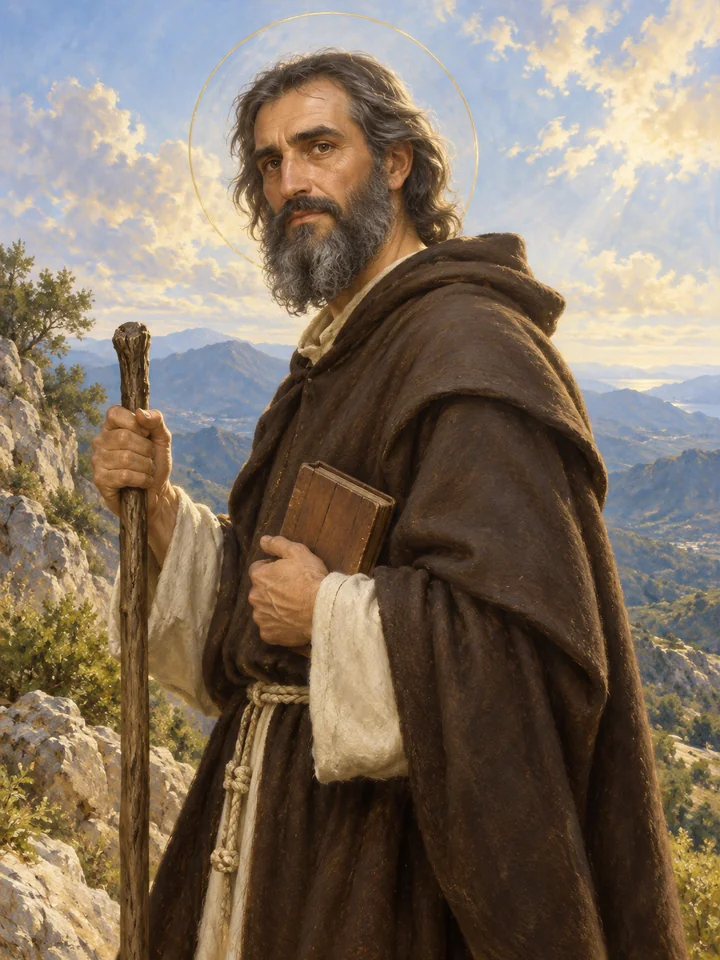
William of Montevergine, or William of Vercelli, (Italian: Guglielmo) (Latin: Gulielmus) (1085 – 25 June 1142), also known as William the Abbot, was a Catholic hermit and the founder of the Congregation of Monte Vergine, or "Williamites ". He is venerated as a saint by the Roman Catholic Church.
Life
He was born in 1085 into a noble family of Vercelli in northwest Italy and was brought up by a relation after the death of his parents. He undertook a pilgrimage to Santiago de Compostela. On his pilgrimage to Compostela, William asked a blacksmith to make an iron implement that would encircle his body and increase his suffering, and he wore it throughout the pilgrimage.
After he returned to Italy, he intended to go to Jerusalem and for this purpose, he reached Southern Italy, but he was beaten up and robbed by thieves. William considered this misfortune a sign of God's will to stay in South Italy and spread the message of Christ.
Because of this, he decided not to travel to Jerusalem anymore and to settle in Southern Italy, on the summit of Monte Vergine (then known as Monte Vergiliana) between Nola and Benevento, where he lived as a hermit. Here he attracted a number of followers and founded the Monastery of Montevergine.
While at Montevergine, William of Vercelli is stated as having performed miracles. Roger II of Sicily served as a patron to William, who founded many monasteries for men and women in Sicily. The Catholic Encyclopedia states that Roger built a monastery opposite his palace at Salerno in order to have William always near him.
The inflow of the faithful was for the priests the opportunity to exercise their ministry, and the hermit life that William sought was compromised. Moreover, his confreres did not tolerate that lifestyle too austere and full of privations. Therefore, he left Montevergine in 1128 and settled on the plains in Goleto, in the territory of Sant'Angelo dei Lombardi, between Campania and Basilicata, where he founded the Abbey of San Guglielmo al Goleto.
Subsequently, he founded several other monasteries of the same rule but mostly remained in Goleto except for some trips to Apulia. Eventually, he died in Goleto on June 25, 1142.
His remains were buried in Goleto, where they stayed until they were transferred to Montevergine on September 2, 1807, as ordered by the king of Naples Gioacchino Murat. Some of his relics are also located in other cathedrals (Benevento ) and Italian churches. Catholic tradition states that William foresaw his own imminent death "by special revelation".
Biography adapted from Wikipedia contributors under CC BY-SA 4.0. Read attribution and adaptation details.